Your Brain Doesn't Prioritise Safety. It Prioritises Survival

Flight Deck Conversations – Series 2, Episode 4
There is a common belief in aviation that when something unexpected happens, training simply "kicks in." We like to think that years of experience, technical knowledge and countless hours of practice will automatically produce the right response when it matters most.
The reality is more complex.
Before your brain can apply procedures, analyse options or make sound decisions, it must first answer a much more fundamental question:
"Am I in danger?"
That question is not asked consciously. It is asked by the oldest parts of your brain, long before your rational thinking has fully engaged.
Understanding this simple concept changes how we should think about training, performance and safety,
not just in aviation, but in every high-pressure profession.
Your Brain Has One Primary Job
Despite what we often tell ourselves, your brain was not designed to fly aeroplanes.
It evolved over hundreds of thousands of years to solve one problem:
Keep you alive long enough to reproduce.
Long before aircraft, vehicles or complex technology existed, survival depended on recognising threats quickly and reacting immediately.
If something moved unexpectedly in the bushes, hesitation could be fatal.
If danger appeared, there was no time for detailed analysis.
Speed mattered more than accuracy.
Although our world has changed dramatically, our biology has not.
Today, the same neural systems that once protected us from predators are still responsible for detecting danger. The difference is that modern threats often require careful thinking rather than immediate physical action.
An engine failure after take-off, an unexpected weather encounter or a rapidly changing operational situation rarely rewards panic. They demand judgement, prioritisation and deliberate decision-making.
Unfortunately, your brain doesn't automatically know the difference.
The Thinking Brain Versus the Survival Brain
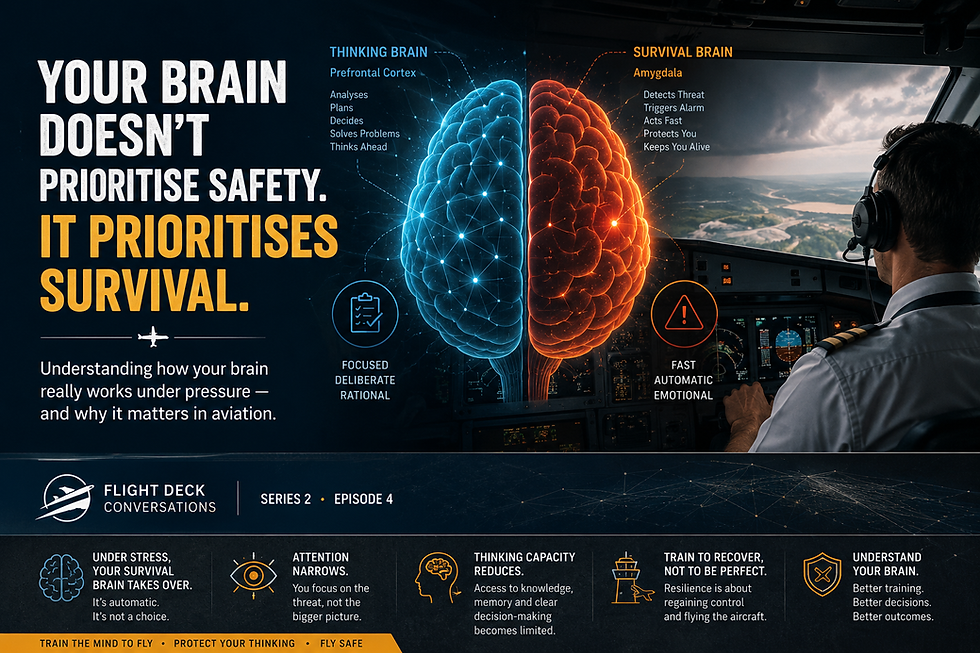
During normal operations, much of our decision-making is controlled by the prefrontal cortex.
This is the area responsible for:
Planning.
Judgement.
Problem solving.
Decision-making.
Managing competing priorities.
Inhibiting impulsive reactions.
It is the part of the brain that allows a pilot to brief an approach, evaluate weather, monitor systems and think ahead.
However, when the brain detects an immediate threat, another system rapidly takes control.
The amygdala acts as an early warning system, initiating a cascade of physiological responses designed to maximise survival.
Heart rate increases.
Breathing changes.
Peripheral vision narrows.
Working memory becomes limited.
Attention rapidly shifts towards whatever appears to be the greatest threat.
These responses occur automatically.
They are not evidence of poor discipline or inadequate professionalism.
They are evidence that you are human.
Survival Is Not the Same as Safety
This is perhaps the most important distinction.
Your survival brain asks one question:
"How do I survive the next few seconds?"
It does not ask:
What does the checklist say?
What does the operations manual require?
What is the safest long-term decision?
What would my instructor expect?
Those questions belong to the thinking brain.
Unfortunately, the thinking brain temporarily loses capacity during periods of acute stress.
This explains why capable, experienced professionals sometimes appear to make surprisingly poor decisions under pressure.
It is rarely because they lacked knowledge.
It is because biology temporarily changed how that knowledge could be accessed.
Why We Sometimes "Know" but Can't Think
Almost everyone has experienced this phenomenon.
You suddenly forget a person's name.
You walk into a room and can't remember why.
You receive unexpected bad news and struggle to process simple information.
Nothing disappeared from your memory.
Your ability to retrieve it temporarily changed.
The same process occurs in aviation.
Many accident investigations reveal pilots who clearly understood the correct procedure but were unable to execute it effectively once surprise, startle or rapidly increasing workload disrupted cognitive performance.
Knowledge remained.
Access deteriorated.
Understanding this distinction changes how we evaluate performance.
Instead of asking:
"Why didn't they know?"
Perhaps we should ask:
"What prevented them from accessing what they already knew?"
The Real Risk Is Cognitive Narrowing
One of the earliest effects of stress is attentional narrowing.
The brain begins allocating increasing resources towards what it believes is the greatest immediate threat.
Sometimes this is exactly what we need.
Sometimes it becomes dangerous.
Imagine an engine begins running rough immediately after take-off.
Attention is naturally drawn towards diagnosing the engine.
Eyes move inside the cockpit.
Thoughts focus on troubleshooting.
Meanwhile, the aircraft continues climbing, slowing or drifting from the intended flight path.
The greatest threat may no longer be the malfunction itself.
It may be the gradual loss of awareness outside the cockpit.
This is why one of aviation's oldest principles remains remarkably relevant:
Aviate. Navigate. Communicate.
It is not merely a sequence of tasks.
It is a cognitive strategy.
It deliberately redirects attention back towards the highest priority before allowing lower-priority problems to consume valuable mental capacity.
What This Means for Training
If human performance changes under pressure, then training must do more than teach procedures.
It must teach people how to recover their thinking.
This is where scenario-based training becomes so valuable.
Rather than simply rehearsing technical skills under calm conditions, realistic scenarios introduce:
Uncertainty.
Time pressure.
Competing priorities.
Startle.
Surprise.
Decision-making under workload.
The objective is not to eliminate stress.
That is impossible.
The objective is to shorten the time it takes for the thinking brain to regain control.
Every successful recovery strengthens cognitive resilience.
A Different Measure of Performance
Traditionally, aviation has judged performance by technical accuracy.
Did the pilot complete every checklist item?
Did they follow the correct procedure?
Did they avoid mistakes?
These remain important questions.
However, they may not tell the whole story.
Perhaps an equally valuable question is:
"How quickly did they regain the ability to think clearly?"
Because resilience is not measured by never becoming overloaded.
It is measured by recognising overload, adapting and restoring effective decision-making before errors compound.
That is a skill.
Like any skill, it can be developed.
Final Thoughts
Human performance is not simply about knowledge, experience or technical ability.
It is about understanding how the brain behaves when pressure increases.
The survival system is not your enemy.
It has kept our species alive for thousands of generations.
But in modern aviation, survival alone is not enough.
Safe outcomes depend on our ability to recognise when biology begins taking control and deliberately restore our capacity to think.
The future of aviation training will not be defined solely by producing technically proficient pilots.
It will be defined by producing professionals who understand their own minds.
Because before we can fly the aircraft safely, we must first learn to manage the most important system on board.
The human brain.
Continue the Conversation..................
Have you ever experienced a moment where you knew exactly what to do, but simply couldn't access it under pressure?
I'd love to hear your experiences.
You can join the conversation on LinkedIn, connect with me on Instagram @JetSheila, or 🎙️ Listen to this week's episode of Flight Deck Conversations.
📱 Follow @srmpilot on Instagram and LinkedIn for more discussions on human performance, safety and decision-making.
If you're interested in learning more about cognitive resilience, human performance and Single-Pilot Resource Management, explore the growing collection of articles and training resources at SRMPilot.com.